
When Water Is More Than Water
The Living Story of St Senan's Well, Scattery Island and the Cathach
There are some places in Ireland that ask us to slow down. Places where the landscape seems to hold something of its own, where the stories feel close to the surface and where what we see is only part of what is there. Scattery Island, or Inis Cathaigh, is one of those places. Sitting in the Shannon Estuary just off Kilrush in County Clare, the island carries more than 1,500 years of history. Its churches, monastic remains, round tower, graves and former village tell of generations who lived, prayed and worked there, while its stories of Saint Senan and the Cathach have travelled through time.
For us, Scattery is more than a place we know through history. It is connected to our own ancestry and to the people who came before us. Recently, three of us were guided to return to the island. We each come from different healing backgrounds and have different ways of working with energy, the nervous system, nature, shamanic land healing and ancestral connection. We did not travel there as archaeologists, hydrologists or conservation scientists. We travelled as practitioners and descendants, returning to a place that is part of our own lineage, with an intention to listen.
What we experienced there brought us into a much deeper conversation about something that has always been central to human life: water.
The Well
West of the round tower lies Tobar Senán, St Senan's Well. County Clare's Heritage Office records it as a natural spring that maintains a flow throughout the year. When Scattery was inhabited, the well served as the village water source, and its waters became associated with healing, particularly for sore eyes. The old stories also tell of Senan being guided to the spring during a time of drought, when fresh water emerged from the earth.
Whether we understand this as miracle, sacred story or the preserved memory of a precious natural spring, the meaning carried through generations was the same. This was a source. People depended upon it. They came to it for water, for healing and for connection.
The old Pattern of Scattery tells us even more. Pilgrims travelled through the island, stopping at a series of sacred places, praying and performing their rounds. St Senan's Well was the eleventh and final station. The journey ended at the water.
That is important. The well was never simply a stone structure with water inside it. People walked towards it. They prayed beside it. They drank from it. They sought healing there and returned again. The relationship between the well and its people was part of the life of the well itself.
Across Ireland, the relationship with healing wells was not always limited to drinking the water or washing a particular part of the body. Some wells were built for immersion, with stone seats carefully carved within them, suggesting that people entered the healing waters fully. The body itself became part of the encounter. To step into healing water is different from standing beside it. You are surrounded by it, held within it, feeling the temperature against the skin and becoming part of the element rather than remaining outside it.
Perhaps this is part of what pilgrimage has always offered. The path towards the well can also become a path towards the heart, towards remembrance and towards conscious unity, flowing as one with who we truly are. The walking, the prayer, the landscape and the water are no longer separate experiences. They become part of one journey.
Ireland has thousands of sacred wells and springs, and although their individual histories differ, this pattern appears again and again. People did not simply collect the water and leave. They entered into relationship with the place through prayer, pilgrimage, ritual, offerings and presence. The well became somewhere to meet.
The Dragon
Then there is the Cathach, the great serpent or dragon of Scattery. According to tradition, when Saint Senan came to Inis Cathaigh, he encountered the creature and drove it away. The story became part of the Pattern of Scattery and remains one of the island's most powerful legends.
But perhaps old stories can sometimes be listened to in more than one way. The dragon has often been portrayed simply as something dangerous that had to be overcome. Yet across many traditions, the serpent or dragon also carries ideas of power, protection, guardianship, transformation and the threshold between one state and another. It stands at a threshold. It guards something.
When we spent time on Scattery, the Cathach and the well began to feel like two parts of something much older and deeper. We experienced the dragon as a more outward, protective and active masculine energy, while the well carried the receptive, nourishing, inward and flowing quality of the feminine. Not male and female in a biological sense, but complementary forces: fire and water, guardian and source, protection and nourishment, giving and receiving.
This is our spiritual interpretation, not a claim that the historical people of Scattery described the Cathach and the well in these exact terms. Our knowledge of the ancient Druids is limited, and we should be careful not to turn modern spiritual understandings into historical fact. What we do recognise is an older way of seeing the natural world as deeply interconnected with human life. Land, water, nature, spirit and people were not necessarily experienced as separate.
Within our own work, we understand energy as continually moving and interacting. Balance is not created by one force defeating another. It is created through relationship. This is part of what we mean spiritually when we speak of cosmic law: that all things are connected, that energy moves through relationship and that when one part of a living system is disturbed, other parts can be affected.
Close to the well stands another remarkable part of Scattery's sacred landscape: its round tower. The tower rises above the island, while the spring emerges from below. With its four upper windows opening towards the directions, the tower creates a striking image of connection between earth and sky, below and above. Historical records also describe evidence of lightning strikes on the tower. For us, standing between the tower and the well brought a deeper sense of a landscape working through different expressions of energy: the tower reaching upwards and the well flowing from beneath.
We understand this spiritually as an intelligent relationship between earth, water, sky and human consciousness. We do not present the idea that the tower was deliberately built to harness lightning as established archaeological fact. What we experienced was the sense that these structures were not isolated from one another, but formed part of a larger energetic landscape in which the tower, the well and the surrounding land worked harmoniously together.
The more we listened, the more the old story seemed to shift. The dragon and the well no longer felt like two separate things. They felt like two sides of a balance.
The Water Began to Answer
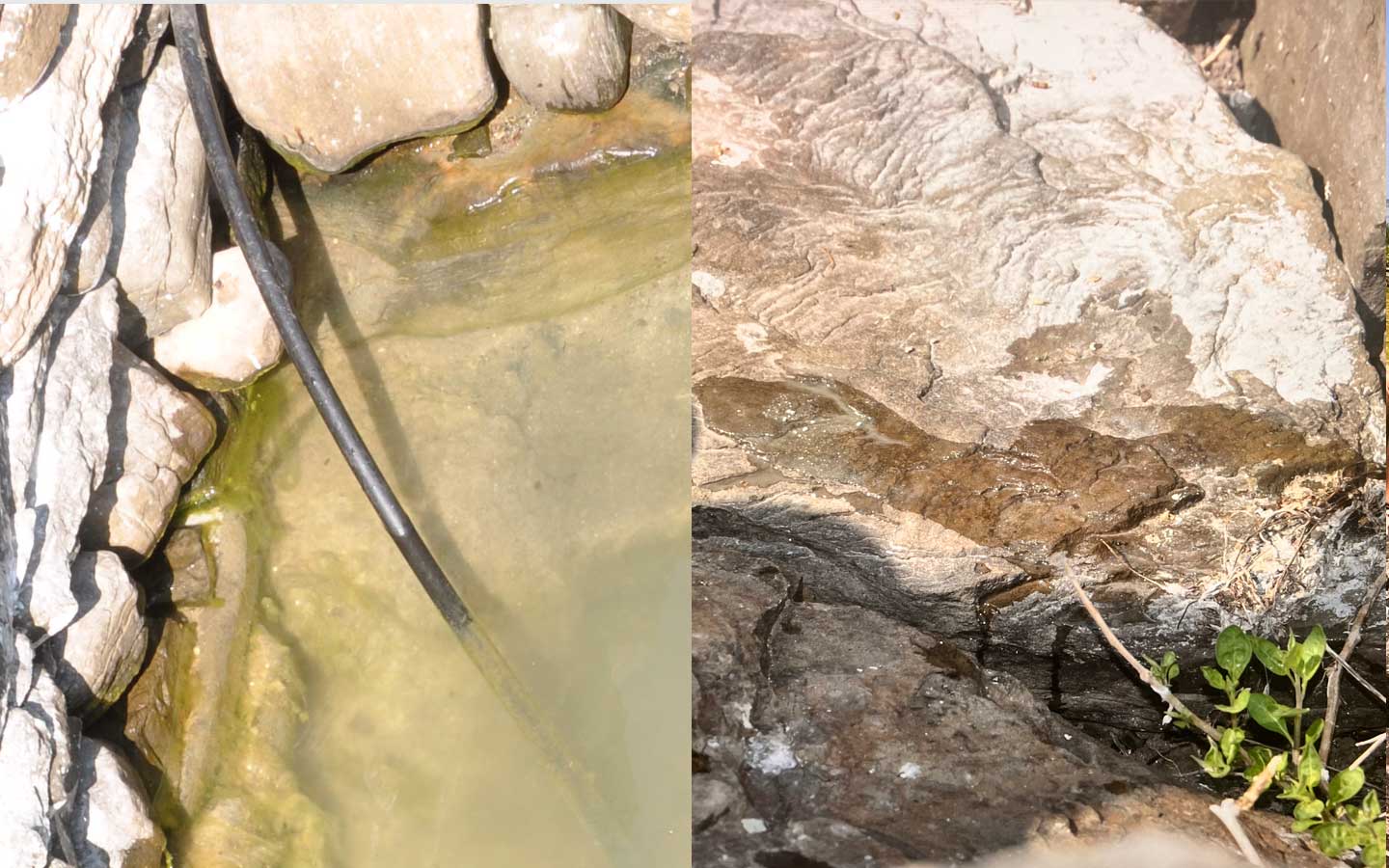
Before we left the well, we carried out a clearing ceremony, working together with the intention of honouring the water, the land and the history held within the place. When the ceremony was complete, something happened that stopped us in our tracks. As the water moved and splashed against the stone of the well, the shape that emerged on the stone appeared to us as a dragon.
We had already experienced the Cathach and the well as two complementary forces within the island, masculine and feminine, guardian and source, fire and water. To then see what looked unmistakably to us like a dragon revealed on the stone by the movement of the water felt deeply significant.
We experienced it as a confirmation of the message we had received: the dragon had returned, the relationship between the dragon and the well was still there, and the story had not been lost.
We cannot claim that the shape appearing in the water is scientific proof of anything beyond what we witnessed. But spiritual experiences are often recognised through moments that are deeply personal and difficult to explain. For the three of us, standing together at the well after the ceremony, it was one of those moments. We had come to listen, and the experience seemed to answer.
The Question of Water
Perhaps this is why we have become so interested in the growing conversation around water consciousness. Long before modern science, people treated certain waters as sacred. Today, people such as Veda Austin are asking new questions about what water may be capable of holding, expressing and responding to.
Through her freezing technique and detailed photography, Austin explores whether water can reflect information associated with words, emotion, intention and imagery. She describes water as responsive and as carrying a form of intelligence that may become visible through the patterns formed during freezing.
Her work is fascinating, although her claims about water responding to human consciousness have not been established as mainstream scientific fact. We believe that distinction matters. We do not need to pretend that something has been scientifically proven when it has not. At the same time, the absence of scientific consensus does not mean we have to stop asking questions.
Science already shows us that water is far more dynamic than it appears. A natural spring is connected to groundwater, geology, minerals, sediments and the environment around it. Irish research into sacred wells has demonstrated the diversity of these groundwater systems and the influence that human activity can have upon them. Beneath the surface there is also microscopic life that cannot be seen with the naked eye, yet forms part of the living freshwater environment.
So perhaps the question is not simply, "Is water conscious?" Perhaps we can begin with something simpler: what if we stopped treating water as though it were merely a resource?
Returning to the Source
This is one of the reasons the work of Charlotte Emily Rose has resonated so strongly with us. Charlotte has spent years returning to forgotten wells, uncovering them and restoring their relationship with the communities around them. Her work in Kinsale has brought more than one hundred forgotten wells back into view, many by clearing away what had accumulated around the source and allowing spring water to flow again. Her book, Well-Being, explores the relationship between restoring wells, restoring flow and remembering our connection with living water.
What is so powerful about this work is its simplicity. The water was already there. The source had not disappeared. Something had gathered around it and hidden it from view. The work was to return, to uncover, to clear and to allow the water to flow again.
It made us wonder what it means to care for a sacred well to be truly a guardian. Is it enough to preserve the stones around it? Or do we also have a responsibility to understand the source, the flow, the water and the relationship between the well and the people who have depended upon it?
Returning to Scattery
When the three of us stood at St Senan's Well, we approached it with respect and with the intention to listen. Each of us experienced the island through our own abilities and practices, but what emerged between us was remarkably consistent. The well was asking to be cared for.
We experienced her as unwell. Not simply as an old well needing maintenance, but as a living spring that had served the people of Scattery for generations and was now asking to be heard again.
The feeling we received was that her relationship with her people had been interrupted. Where generations had once encountered the source itself, visitors are now offered only a small bowl of water for healing. For us, this felt like a profound disconnection from the relationship that had always formed part of the well's purpose.
She did not feel as though she wanted simply to be looked at. She wanted to be recognised for the service she had given. She had provided water. People had walked to her. They had prayed beside her, sought healing, given thanks and carried her water away. Human contact had always been part of her story.
When we looked more closely, we were struck by what we experienced as a physical and energetic change. The walls were white. A large black hose was present within the well area. When the water was disturbed, it became cloudy.
We cannot determine scientifically what caused these observations, and we believe that any changes to the water should be properly assessed by appropriate environmental and hydrological experts. But we can speak honestly about what we experienced. Energetically, the spring felt constricted. The natural movement felt restricted. The sense of communication between the water, the land and the people felt interrupted.
What we felt most strongly was not anger. It was a deep sadness for something that had given so much to its people and now felt separated from them.
When We Intervene in Living Water
We have become particularly concerned about the limestone intervention around the well. We want to be careful with this because limestone itself is not inherently harmful. Calcium carbonate is deliberately used in some water systems, particularly where acidity needs to be reduced. Its effects depend on the chemistry of the particular water system, the quantity used, the method of application and the surrounding environment.
Research also shows that changing calcium carbonate, water hardness and alkalinity can change freshwater conditions and affect living organisms. This does not mean that limestone is always damaging. It means that introducing material into a natural spring changes the conditions within that system and deserves to be properly understood.
That is why our question is not whether limestone is simply "good" or "bad". Our question is much more specific: is this intervention appropriate for St Senan's Well? What was the purpose? What was applied? In what quantity? What has been measured before and after? And is the natural flow and wider water system being protected?
From our perspective as healers, the limestone felt like a constriction. We experienced it as something that was interfering with the natural expression of the spring. We understand that this is an energetic experience, not a scientific measurement. But perhaps both questions deserve to be asked. What is happening physically to the water, and what is happening to our relationship with the source?
A natural spring is part of a much larger system. The water beneath the ground, the geology through which it travels, the minerals and sediments, the microscopic life within the water and the landscape around it all form part of the living environment. A well may look small from the surface, but what lies beneath is not small.
Remembering the Relationship
This is where the old and the new can meet. Archaeology can help us understand what remains. Folklore can preserve memories. Hydrogeology can help us understand the movement and chemistry of groundwater. Environmental science can examine what happens when a spring's conditions change. Modern research can ask questions about water and consciousness. Spiritual practice gives us another way of listening to meaning, relationship and place.
None of these forms of knowledge needs to cancel another. We can know what has been scientifically established. We can respect what history records. We can recognise what remains uncertain. And we can be honest about what we experience spiritually.
For us, this is why education matters. We cannot protect what we do not understand. If someone sees a holy well as an old stone structure containing water, they may never understand why it mattered. But when we understand the source, the spring, the land, the stories, the pilgrimage, the people, the ecology and the spiritual significance, we begin to see something very different.
Scattery island is a place of enormous historical and cultural significance, and its conservation is a complex responsibility. What we hope for is a wider conversation about what it means to protect and be a living wisdom keeper/guardian a sacred spring: not only preserving what can be seen, but understanding the living water, the natural flow, the environment and the relationship that has existed between the source and its people.
A Message From the Well
We have thought carefully about how to describe what happened when the three of us connected with St Senan's Well. We cannot prove that a well can communicate with human beings in the scientific sense, and we do not present our experience as scientific evidence. We can only tell you what happened for us when three practitioners, each with different abilities and different ways of working, stood together at the source and listened.
The message was simple.
The well asked to be remembered.
She asked to be approached again. She asked for relationship rather than separation. She asked to be cared for, not simply preserved. She asked for her natural flow to be understood and respected.
She asked us to remember the connection between the well, the Cathach, the land and the people who have been part of her story for generations. She asked to be recognised not simply as a historic feature, but for the service she has given through human contact.
Perhaps our responsibility now is not simply to preserve what remains, but she asked us to reach out again and tounderstand what we have inherited.
The old Irish traditions remind us that water can be sacred. The story of Scattery places the well within a landscape of faith, healing and pilgrimage. Modern hydrogeology shows us that springs are dynamic systems connected to the earth beneath us. Contemporary voices ask us to reconsider what we understand about water and consciousness. Charlotte Emily Rose reminds us that forgotten wells can be found, cleared and returned to their communities.
Perhaps what we need now is not to choose between the old and the new, but to learn how to listen to both. Before we can protect something, we have to understand it. Before we can change something, we have to be willing to listen. And before we can ask others to care, we have to remember why the place matters.
St Senan's Well is still there. The water is still there. Her ancient counterpart, the Cathach, is still part of her story. And if we are willing to understand the relationship between them, the story is still alive.
Perhaps now it is time for us to reach out again.
Further Reading and Sources
The historical and heritage information in this article draws from the County Clare Heritage Office, Heritage Ireland / Office of Public Works, the Heritage Council, the Irish National Inventory of Intangible Cultural Heritage and research into Irish holy wells and their hydrogeology. Contemporary perspectives include the work of Veda Austin and Charlotte Emily Rose. Our spiritual interpretation and experience of Scattery are presented as the perspective of Love & Light Ireland and are not presented as scientific conclusions.
County Clare Heritage Office – Tobar Senán / St Senan's Well
Ask About Ireland – The Pattern at Scattery
Office of Public Works – Scattery Island 2026
Heritage Council – Holy Wells of Ireland
Ireland's National Inventory of Intangible Cultural Heritage – Holy Wells in County Clare
Misstear & Gill (2024) – The Hydrogeology of Sacred Wells: Insights from Ireland
Rapid Changes in Water Hardness and Alkalinity: Calcite Formation Is Lethal to Daphnia magna